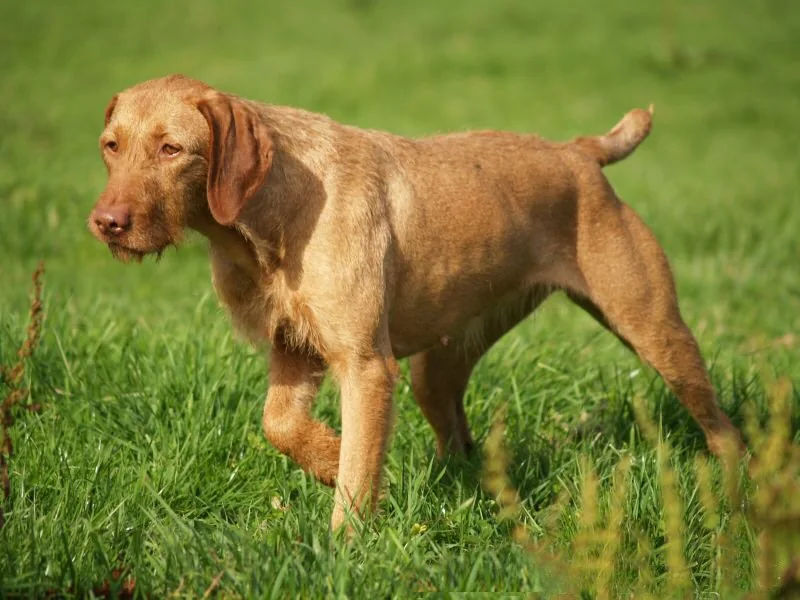
Hungarian Wirehaired Vizsla: close wire hair with undercoat
The Wirehaired Vizsla has a more robust frame than the shorthaired Vizsla and a close, dense wire coat. Outings and shared activity take substantial daily time. Coat care is comparatively simple in its AKC guide, with more loose hair to manage during shedding.
Separate the height and hair descriptions
The FCI gives males 58–64 cm and females 54–60 cm at the shoulder, placing balance and symmetry above increasing height. The earlier UK ranges are 58–62 cm and 54–58 cm, permitting variation of less than 3 cm if proportion is maintained. Neither gives a numerical weight here.
The FCI outer coat is 2–3 cm long, wiry, dense and close-lying over water-repellent undercoat. The UK describes body hair up to 4 cm. Both describe a slightly longer-than-tall body, with the stronger build and wire coat distinguishing this profile from the shorthaired Vizsla.
Wipe-downs and seasonal loose hair
The AKC guide recommends a damp-cloth wipe between baths, with a grooming mitt or shedding knife during shedding. Ask a groomer to demonstrate the suitable tool and pressure if it is unfamiliar. The earlier UK guide places grooming above once weekly.
The AKC routine mentions monthly baths, nail trimming every four weeks and starting dental care early. Keep the mitt ready for the shedding period and use the quieter coat sessions for dental handling and checking nail length.
Make exercise something you do together
The UK guide places daily exercise above two hours and allows town or country, with a large house and garden. The AKC suggests hiking, jogging or cycling with the owner and opportunities to run, preferably in a securely fenced space. Plan the safe setting as well as the activity, instead of relying on recall as the only boundary.
Compare wire and short coats
The shorthaired Hungarian Vizsla has no undercoat in its FCI description and uses a rubber brush in its care routine. The German Wirehaired Pointer has a 2–4 cm outer coat and an AKC comb-and-soft-slicker routine. Those differences are more useful for choosing tools than the presence of a beard alone.
Sources and further reading
Hungarian Wirehaired Vizsla at a glance
These earlier UK breed guides are starting points for comparison. Details may have changed, and individual dogs vary.
- Breed group
- Gundog
- Size
- Large
- Daily exercise
- More than 2 hours per day
- Grooming frequency
- More than once a week
- Coat length
- Medium
- Sheds
- Yes
- Suggested home size
- Large house
- Town or country
- Town or country
- Garden recommendation
- Large garden
- Lifespan
- Over 10 years
FCI breed standard
Standard guidance describes the breed ideal; individual dogs vary.
- Origin
- Hungary
- Group
- 7 - Pointing Dogs
- Section
- 1 - Continental Pointing Dogs
- Height
- Males: 58–64 cm; Females: 54–60 cm
- Weight
- Not specified in this standard
This wire-haired Vizsla has dense undercoat and its own numbered standard. FCI gives no weight and stresses balance and symmetry over size.
Official FCI standard (PDF)
Standard effective from 2000-04-06; checked 2026-10-15