Braque d’Auvergne: short-coat care and separate height tolerances
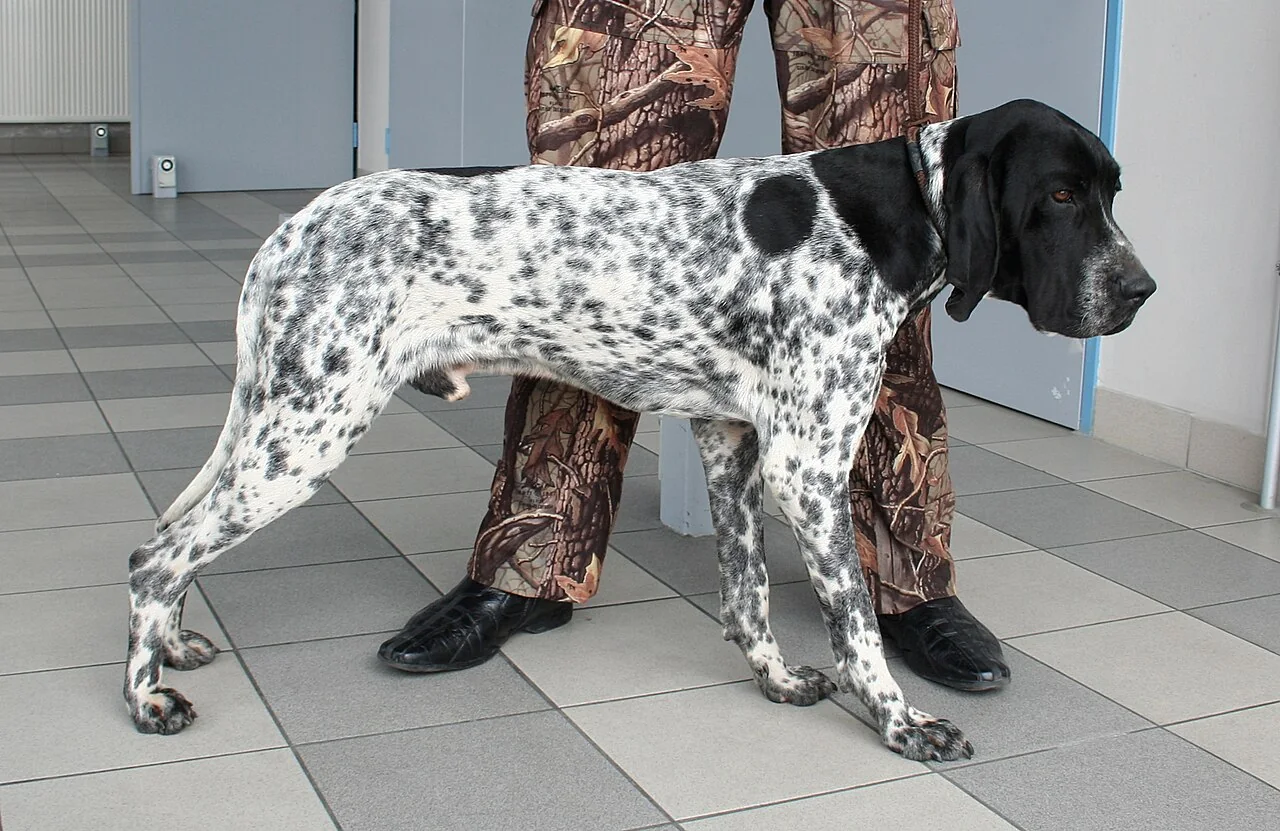
The Braque d’Auvergne has a strongly boned body beneath a short, glossy coat. Its black-and-white markings can create a blue impression at a distance. The useful daily comparison combines its own dimensions, brief coat work and outdoor activity, rather than using another French pointer’s description.
Ranges, ideals and tolerances
Both FCI and the earlier UK guide give male heights of 57–63 cm, ideally 60 cm, and female heights of 53–59 cm, ideally 56 cm. Their tolerances differ: UK allows 3 cm either way, while FCI states 2 cm above and 1 cm below for both sexes. Keep those conditions with their respective accounts. Neither supplies a numerical weight here.
Body shape and short hair
FCI describes body length as approximately equal to height, while UK describes it as just slightly longer. Both describe chest depth as half the height, a straight topline and a long, deep chest reaching the elbow. The coat is short, shiny, not too fine and never hard. Its gloss does not remove the need to attend to loose hair or debris after outdoor activity.
Weekly brushing and daily checks
Purina’s own breed guide suggests a weekly stiff-bristle brush-through, alongside daily checks of ears, lips and paws for debris, grass seeds and other foreign material. Its weekly brush frequency sits alongside the UK weekly grooming category. Ask for a comfortable handling demonstration, particularly around ears and feet. This is a practical coat-and-outings routine, without adding a compulsory bath interval or borrowing a trimming programme from a feathered breed.
Adult outings and comparisons
The UK category is more than two hours of daily exercise, with a large country home and garden. Purina describes two hours or more for an adult dog, combining lead walks, free activity and mental engagement. Keep that adult scope and its threshold separate from the UK category when planning an individual dog’s outings. Compare the Brittany’s finer feathering and different height clauses, or the Small Munsterlander’s seasonal coat routine and smaller UK home category.
Sources and further reading
Braque D’Auvergne (Imp) at a glance
These earlier UK breed guides are starting points for comparison. Details may have changed, and individual dogs vary.
- Breed group
- Gundog
- Size
- Large
- Daily exercise
- More than 2 hours per day
- Grooming frequency
- Once a week
- Coat length
- Short
- Sheds
- Yes
- Suggested home size
- Large house
- Town or country
- Country
- Garden recommendation
- Large garden
- Lifespan
- Over 10 years
FCI breed standard
Standard guidance describes the breed ideal; individual dogs vary.
- Origin
- France
- Group
- 7 - Pointing Dogs
- Section
- 1.1 - Continental Pointing Dogs – Type “Braque”
- Height
- Males: 57–63 cm; Females: 53–59 cm; Males: Ideal: 60 cm; Females: Ideal: 56 cm; Tolerance: 2 cm above; Tolerance: 1 cm below
- Weight
- Not specified in this standard
The stated heights and ideal points are separate. The FCI allowance is 2 cm above or 1 cm below, unlike the earlier UK snapshot’s 3 cm in either direction.
Official FCI standard (PDF)
Standard effective from 2004-03-24; checked 2026-10-15