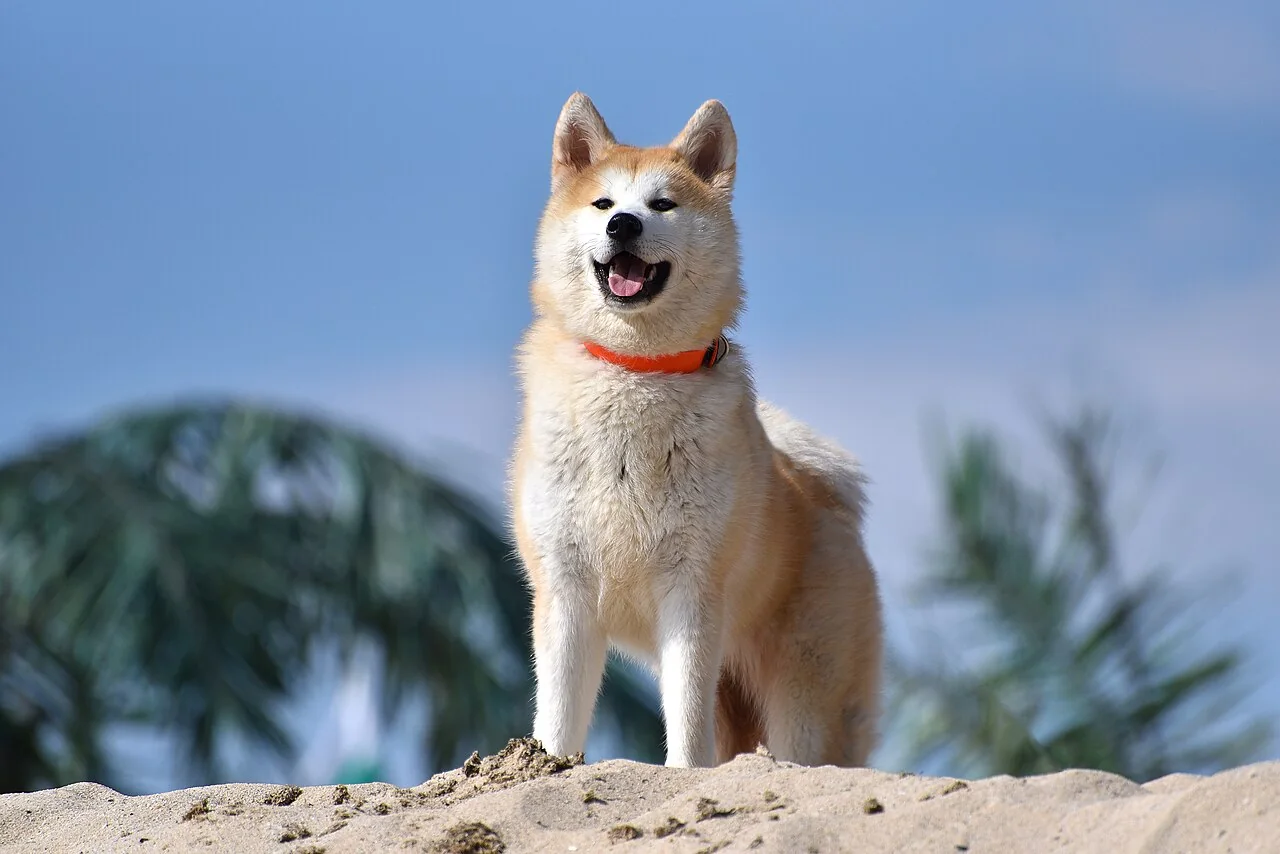
Japanese Akita Inu: a substantial frame and seasonal undercoat work
The Japanese Akita Inu has a sturdy body, harsh straight outer hair and a soft, dense undercoat. Regular walks, mental activity and brushing every few days form the basic routine. Heavy seasonal shedding makes coat care more intensive at particular times of year.
The Japanese Akita description
FCI standard 255 gives males 67 cm and females 61 cm at the shoulder, with 3 cm tolerance either way. The earlier UK ranges are 64–70 cm and 58–64 cm respectively. Neither supplies a numerical weight in these descriptions. Height to body length is 10:11, with females allowed a slightly longer body.
The back is straight and strong, the loin broad and the chest deep. Hair is a little longer at the withers and rump, and longer on the tail. These measurements and proportions concern the Japanese Akita; its own AKC Japanese Akitainu guide supplies the care advice below.
Brush, comb and check
The AKC recommends gentle brushing every few days, with a slicker useful between the heavy sheds. During the twice-yearly undercoat change it describes a bath, cold-air drying and a comb-out to help remove loose hair. Arrange enough time or grooming help for those sessions rather than assuming the short outer coat means little shedding.
Its grooming advice also includes keeping nails trimmed, regular tooth brushing and clean ears. Longer coats need more frequent brushing to avoid matting. These are tasks to practise and discuss with a groomer, alongside the larger seasonal comb-out.
Outings with structure
The earlier UK guide places exercise above two hours daily and describes a large house and garden. The AKC recommends regular walks and mental exercise, keeping the dog leashed in public and around unfamiliar people or animals. Hiking and camping are possible shared activities with appropriate training and precautions, rather than an automatic off-lead option.
Compare the actual commitments
The Shiba is smaller and has its own heavy-shedding coat routine; it is not a scaled-down set of Akita measurements. The Siberian Husky offers a different large-exercise comparison, with lighter proportions and a smoother-lying double coat. Read the daily activity and seasonal care of each alongside its size.
Sources and further reading
Japanese Akita Inu at a glance
These earlier UK breed guides are starting points for comparison. Details may have changed, and individual dogs vary.
- Breed group
- Utility
- Size
- Large
- Daily exercise
- More than 2 hours per day
- Grooming frequency
- More than once a week
- Coat length
- Short
- Sheds
- Yes
- Suggested home size
- Large house
- Town or country
- Town or country
- Garden recommendation
- Large garden
- Lifespan
- Over 10 years
FCI breed standard
Standard guidance describes the breed ideal; individual dogs vary.
- Origin
- Japan
- Group
- 5 - Spitz and primitive type
- Section
- 5 - Asian Spitz and related breeds
- Height
- Males: 67 cm; Females: 61 cm; Tolerance: 3 cm above or below
- Weight
- Not specified in this standard
This is the Japanese Akita Inu profile and the Japanese-origin FCI255 standard. It does not resolve the separate UK Akita profile or transfer these measurements to it.
Official FCI standard (PDF)
Standard effective from 2001-03-13; checked 2026-10-15