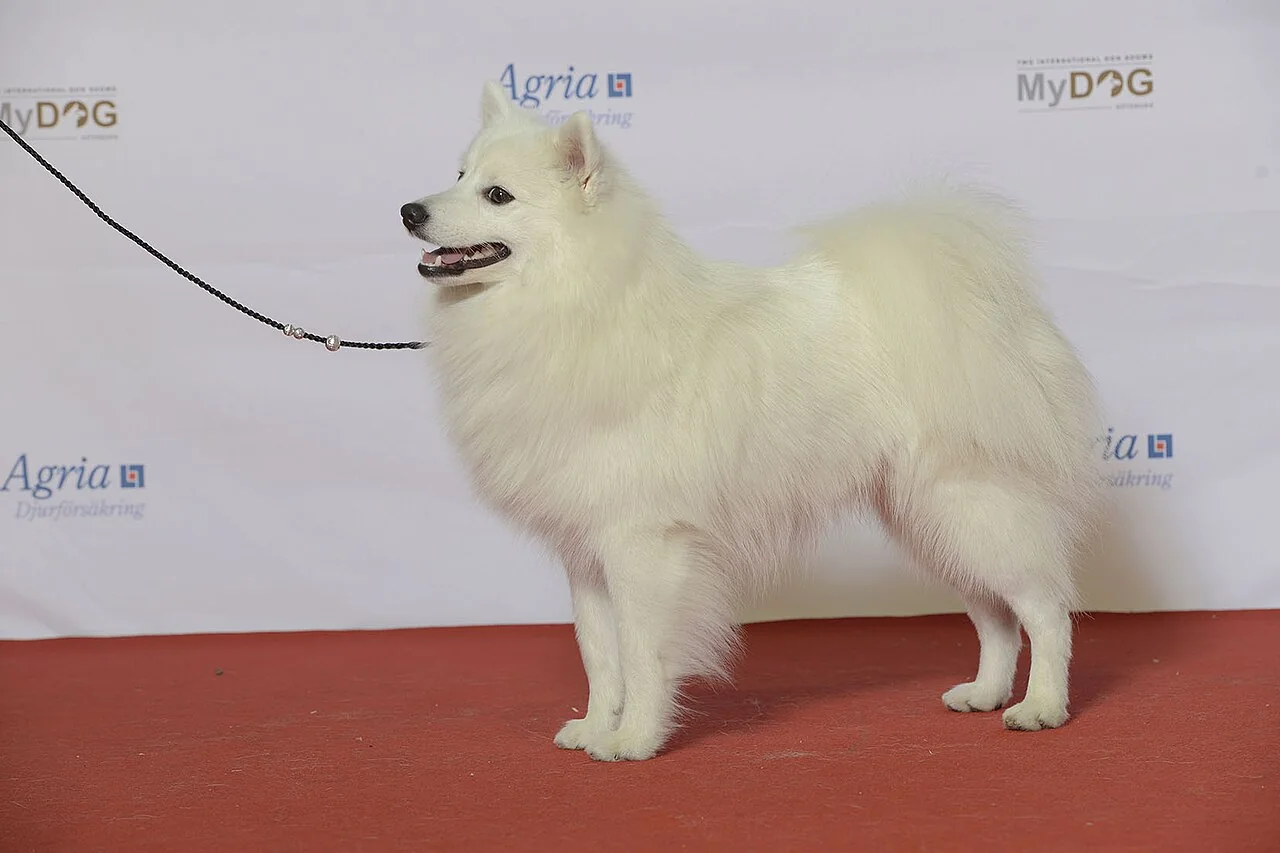
Japanese Spitz: white coat care through the seasons
The Japanese Spitz has a pure white standing coat, a neck frill and a feathered tail carried over the back. The surface can shed dried mud quite readily, but that does not remove the need to brush out undercoat. The biggest change in workload comes during the seasonal shed.
Height and the body beneath the frill
The FCI gives males 30–38 cm at the shoulder and describes females as slightly smaller. The earlier UK guide instead specifies 34–37 cm for males and 30–34 cm for females. Neither provides numerical weight here. Height to body length is 10:11 in the FCI description.
The straight outer hair stands away from short, soft, dense undercoat. Hair is shorter on the face, ears and lower parts of the limbs, while the neck, forechest and tail are abundantly coated. The broad chest and straight back should still be understood beneath that outline.
Weekly brushing, then daily during the shed
The AKC guide describes weekly brushing for much of the year and daily brushing during the two- or three-week undercoat sheds, usually twice yearly. The earlier UK guide uses a daily grooming category. Allow for regular checks as well as those heavier seasonal sessions.
The AKC recommends infrequent bathing unless the dog gets messy, and says dried mud can be brushed out. It also includes regular nail trimming. A clean-looking white surface is not the same as a combed-out undercoat, so keep the two jobs separate when assessing the coat.
Activity in different homes
The earlier UK description allows a small house and small or medium garden, in either town or country, with up to one hour of exercise. The AKC includes both larger spaces and apartments, while still recommending regular walks and interactive outdoor activity. Schedule time to be involved rather than expecting room alone to provide it.
Compare the smaller spitz profiles
The German Spitz Klein has a square FCI outline and its own smaller height description, with shared German Spitz care guidance. The Pomeranian has a separate FCI height of 21 cm with 3 cm tolerance and a detailed pin-and-slicker grooming routine. Compare these practical differences before treating all small, full-coated spitz as one choice.
Sources and further reading
Japanese Spitz at a glance
These earlier UK breed guides are starting points for comparison. Details may have changed, and individual dogs vary.
- Breed group
- Utility
- Size
- Small
- Daily exercise
- Up to 1 hour per day
- Grooming frequency
- Every day
- Coat length
- Medium
- Sheds
- Yes
- Suggested home size
- Small house
- Town or country
- Town or country
- Garden recommendation
- Small / medium garden
- Lifespan
- Over 12 years
FCI breed standard
Standard guidance describes the breed ideal; individual dogs vary.
- Origin
- Japan
- Group
- 5 - Spitz and primitive type
- Section
- 5 - Asian Spitz and related breeds
- Height
- Males: 30–38 cm; Females: slightly smaller; no exact figure given
- Weight
- Not specified in this standard
The female Japanese Spitz is only described as slightly smaller; no female interval is invented. The official publication is dated 1987 by year only in this PDF.
Official FCI standard (PDF)
Standard effective from 1987 (year only); checked 2026-10-15



.jpg)