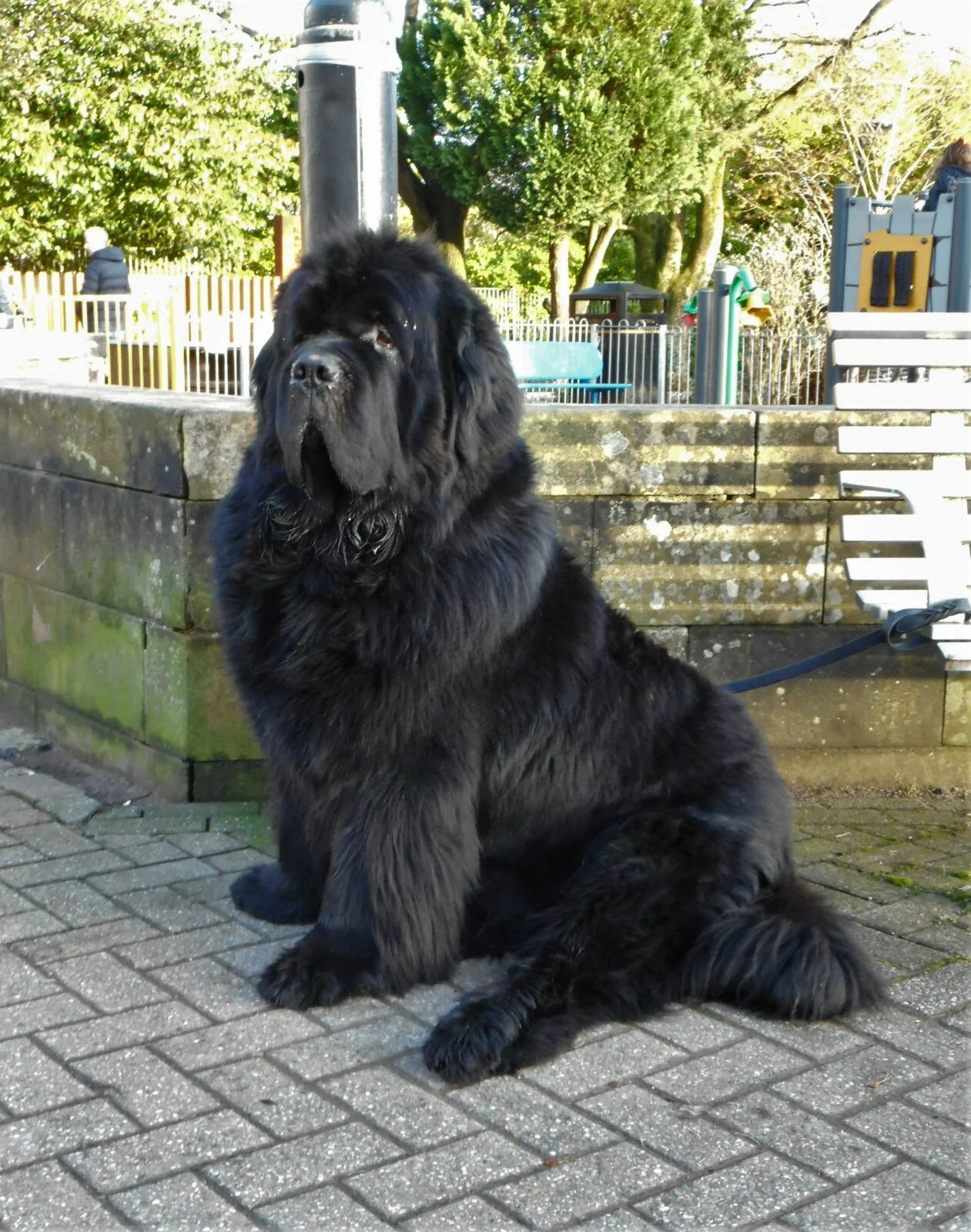
Newfoundland: thorough brushing beneath a heavy double coat
The Newfoundland has a powerful, deep body under a water-resistant double coat. Thorough brush-throughs and seasonal undercoat removal take time. Regular moderate activity belongs alongside that coat work, rather than being replaced by it.
Average size, with balance first
The FCI gives average adult heights of 71 cm for males and 66 cm for females, with approximate average weights of 68 kg and 54 kg. The earlier UK guide gives the same average heights and average weight ranges of 64–69 kg and 50–54.5 kg.
These are averages, not minimums. The FCI favours symmetry, soundness and correct movement over size alone. The body is longer than tall with a firm, level topline. Moderately long outer hair lies over soft, dense undercoat, fuller in winter, with leg feathering and a well-covered tail.
Reach through both layers
The AKC recommends a thorough slicker-brush and long-toothed-comb session at least weekly, becoming daily during seasonal shedding. It notes that neutered dogs may shed year-round and need several sessions weekly. The earlier UK category is daily grooming, so plan smaller checks as well as the complete brush-through.
Regular nail trimming and ear checks are also supported by the care guide. Ask for a demonstration of reaching the undercoat gently if a heavy coat is difficult to work through; smoothing the surface leaves a different job unfinished beneath it.
Moderate daily activity together
The UK exercise category is up to one hour, with a large country house and garden. The AKC suggests at least half an hour of moderate daily activity and lists walks, hikes and swimming among options. Water activities require suitable supervision and conditions; a historical lifesaving role is not proof of an individual dog’s ability.
Compare two other heavy coats
The Leonberger needs daily attention to mat-prone areas and a fuller weekly groom using several tools. The St. Bernard has long- and short-haired varieties with a shared weekly-to-daily shedding routine. Compare the actual layers and handling work alongside the dogs’ different size descriptions.
Sources and further reading
Newfoundland at a glance
These earlier UK breed guides are starting points for comparison. Details may have changed, and individual dogs vary.
- Breed group
- Working
- Size
- Large
- Daily exercise
- Up to 1 hour per day
- Grooming frequency
- Every day
- Coat length
- Medium
- Sheds
- Yes
- Suggested home size
- Large house
- Town or country
- Country
- Garden recommendation
- Large garden
- Lifespan
- Under 10 years
FCI breed standard
Standard guidance describes the breed ideal; individual dogs vary.
- Origin
- Canada
- Group
- 2 - Pinscher and Schnauzer- Molossoid breeds- Swiss Mountain and Cattle Dogs
- Section
- 2.2 - Molossoid breeds, Mountain type
- Height
- Males: Adults: average: 71 cm; Females: Adults: average: 66 cm
- Weight
- Males: Average: about 68 kg; Females: Average: about 54 kg
Newfoundland heights are adult averages and the weights are approximate averages. The standard does not favour size over symmetry, structure and movement.
Official FCI standard (PDF)
Standard effective from 1996-10-29; checked 2026-10-15